> For the complete documentation index, see [llms.txt](https://reference-guide.gitbook.io/crm-back-office-user-guide-full/llms.txt). Markdown versions of documentation pages are available by appending `.md` to page URLs; this page is available as [Markdown](https://reference-guide.gitbook.io/crm-back-office-user-guide-full/11.-notify/email-notifications.md).
# Email Notifications
### 1. Overview
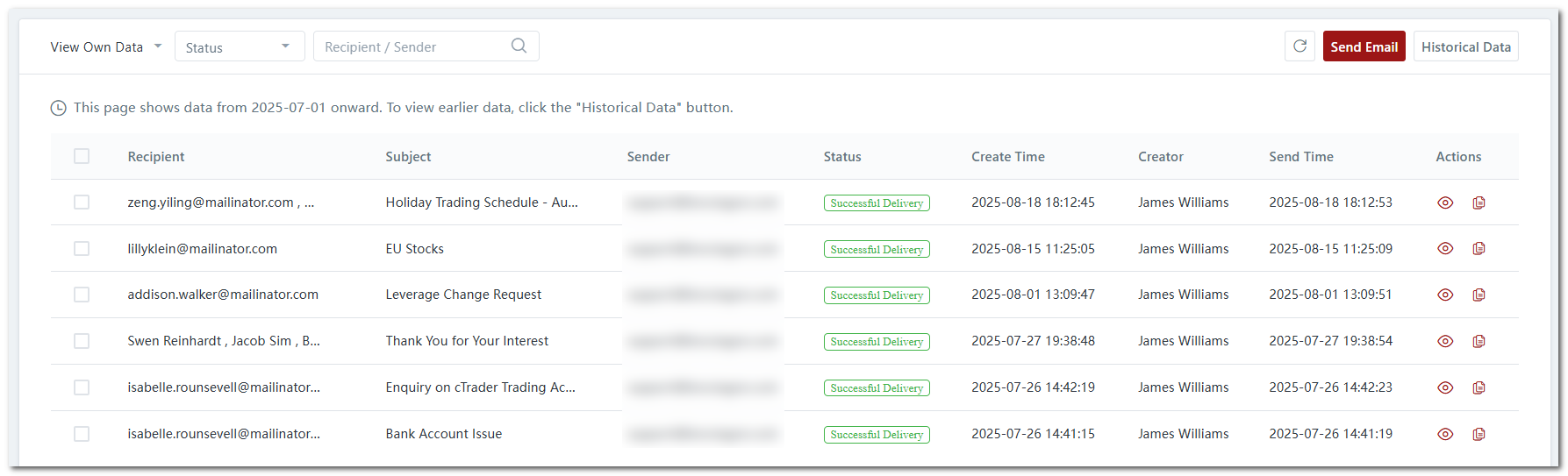
You can access a **comprehensive view of all email notifications** sent to clients. For each notification, the following details are available:
* **Recipient:** Identifies the specific client(s) who received the email.
* **Subject:** Shows the email’s subject line, providing a brief summary of its content.
* **Sender:** Displays the email address from which the notification was sent.
* **Status:** Indicates the current status of the email notification (e.g., sent, pending).
* **Create Time:** Timestamp of when the email notification was created.
* **Creator:** The user who created the email notification.
* **Send Time:** Timestamp of when the email was actually sent to the recipient(s).
### 2. Functions
You can also perform the following functions:
Permissions Dropdown List
1. You have the flexibility to customize email notification permission rights for backoffice users. Permissions can be tailored so that some users view all company emails, while others only access emails created by themselves or their team: [Role Management](/crm-back-office-user-guide-full/17.-settings/back-office-portal-user-settings/role-management.md)
2. You can select different categories to filter and view specific email notifications:
* **View Own Data**: Shows only emails you created.
* **Direct Downlines**: Displays emails created by your direct team members.
* **All Downlines**: Displays emails created by both your direct and indirect team members.
* **Same Role**: Shows emails created by other backoffice users with the same role as you.
* **Company** **Wide**: Shows emails created by any member of the company.
3. To apply a filter, select the desired option from the dropdown list. Status Filter
1. You can also filter email notifications based on their delivery status. The available options are:
* **Draft**: Emails that are being composed or edited but not yet sent.
* **Delivery Failed**: Emails that could not be delivered.
* **Partial Delivery** **Failed**: Emails sent but only partially delivered, with failures to some recipients.
* **Sending**: Emails that are currently in progress of being sent.
* **Successful Delivery**: Emails that were successfully delivered to all recipients.
2. To filter by status, select the desired option from the dropdown list. Search Bar
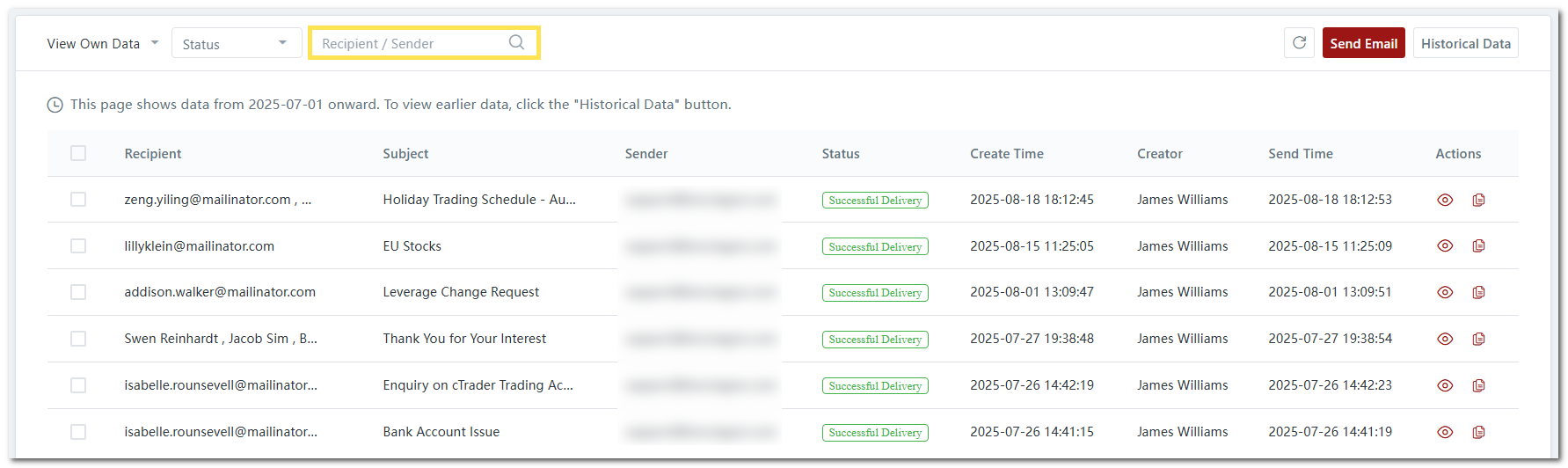
1. You can quickly locate email notifications by searching with the recipient’s name or the sender’s name.
2. Partial match is supported. Refresh
1. You can refresh the page to retrieve the most up-to-date email notifications by clicking the "**Refresh**" button. Batch Delete Email
1. You can batch delete email notification records.
2. You can only delete emails you created, and the "**Delete**" button is available only when viewing the "**View Own Data**" report.
3. Select the emails you want to delete and click "**Delete**" icon.
4. A confirmation popup will appear. Click "**Confirm**" to proceed.\
\

5. The selected email records will then be deleted.
Preview Email
1. You can preview the email content by clicking the "**Preview**" icon.
2. The email will open in a new tab.
Edit Email
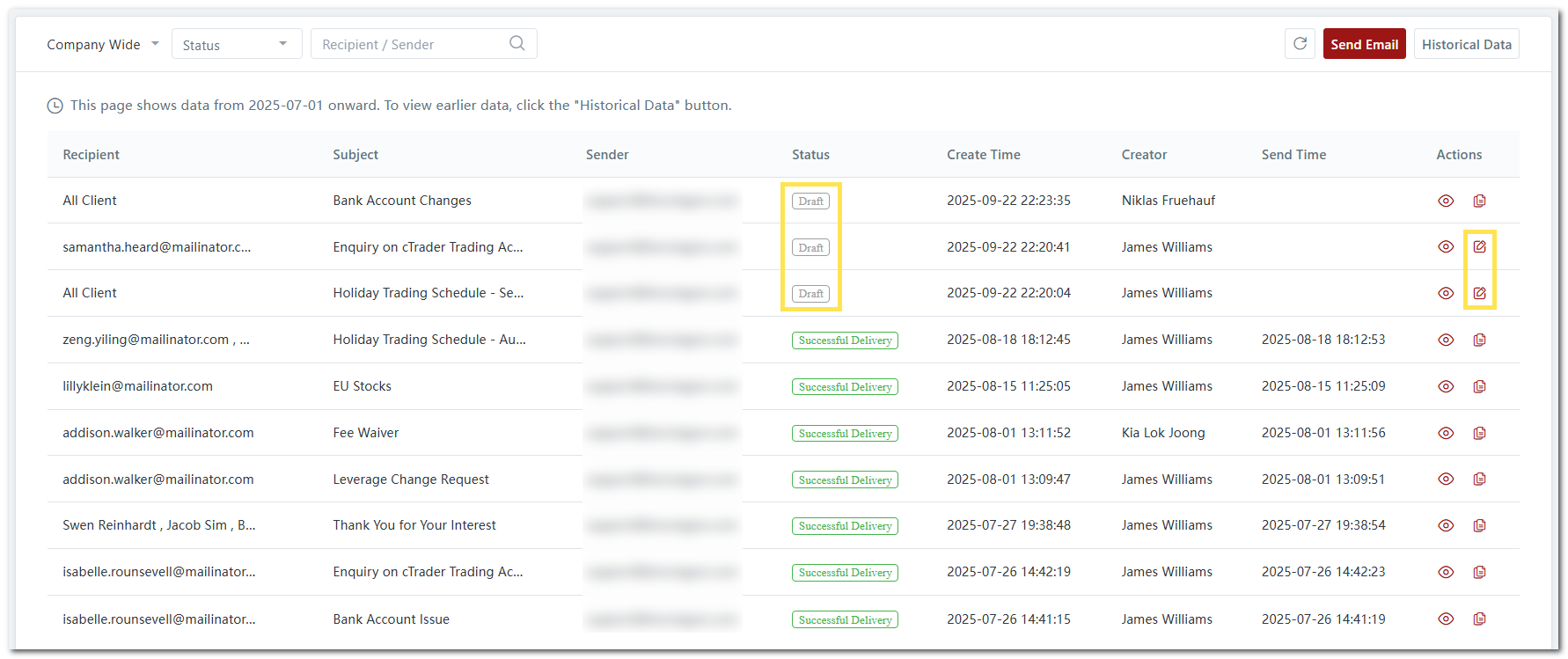
1. You can edit emails by clicking the "**Edit**" icon.
2. Only emails in the "**Draft**" status can be edited.
3. You can only edit email drafts created by you.
4. For drafts not created by you, the "**Edit**" icon will not be available.
5. Make changes to the content and click "**Send**" when ready. For more details, see this section: [Send Email Notifications](/crm-back-office-user-guide-full/11.-notify/email-notifications/send-email-notifications.md) Duplicate Email
1. You can duplicate previously sent emails to conveniently resend similar content to clients.
2. Click the "**Duplicate**" icon to create a copy of the email.
3. The **Duplicate** function is not available for draft emails; the icon will not be shown for drafts.
4. After duplicating, you can amend the email content before clicking "**Send**". For more details on composing email content, see this section: [Send Email Notifications](/crm-back-office-user-guide-full/11.-notify/email-notifications/send-email-notifications.md)