> For the complete documentation index, see [llms.txt](https://reference-guide.gitbook.io/crm-version-release-notes/llms.txt). Markdown versions of documentation pages are available by appending `.md` to page URLs; this page is available as [Markdown](https://reference-guide.gitbook.io/crm-version-release-notes/v7.43.0-streamline-client-communication-with-the-new-notices-feature.md).
# V7.43.0 - Streamline Client Communication with the New "Notices" Feature
Learn about all the details of all our recent CRM updates here.
**Released Date - 20 May 2025**
We’re introducing **Notices**—a powerful new tool that makes it easier than ever to deliver important updates, announcements, and alerts directly within the Client Portal.
Whether it’s a planned system maintenance, regulatory update, or time-limited promotion, Notices ensure your message is seen by the right clients at the right time—reducing reliance on emails or external channels.
Fully customizable in appearance, language, recipients, and display duration, this feature gives you precise control over client-facing communication.
### Key Function Highlights
1. **Customisable Display:** Choose whether a notice appears at the top or bottom of the portal. Adjust alignment as well as font and background colours to reflect your brand or emphasize urgency.
2. **Multi-Language Support:** Set notice content in multiple languages. Clients will automatically see the message in their chosen portal language—ensuring clarity and consistency across regions.
3. **Audience Targeting:** Enjoy the flexibility to assign notices to specific client groups. Share tailored updates or operational alerts only with relevant users—such as VIP clients, specific account types, or regional groups—without broadcasting to everyone.
4. **Scheduled Visibility:** Define a start and end date for each notice. Perfect for time-sensitive alerts, seasonal promos, or scheduled system changes.
### 1) Permission Settings
To start publishing Notices, the appropriate user permissions must be assigned:
1. **Read Notices** – Grants view-only access to existing notices.
2. **Update Notices** – Grants full access to create, edit, publish, and delete notices.
Once these permissions are assigned, the "Notices" option will appear in the side menu under the "Notify" module, allowing you to manage client communications directly.
By default, you will see the notices you have created. Use the dropdown menu to adjust your view to one of the following scopes:
* **Your Own Data** – Notices created by you only.
* **Direct Downlines** – Notices created by your direct downline users.
* **All Downlines** – Notices created by all users in your downline hierarchy.
* **Same Role** – Notices created by users assigned the same Role as you.
* **Company Wide** – Notices created by any user within the company.
### 2) Select Default Notice Position
You can set the default position where notices will appear on the Client Portal. Choose either Top or Bottom to best suit your communication needs.
* **Top:** Notices will be displayed prominently at the top of the Client Portal screen, ensuring maximum visibility.
* **Bottom**: Notices will appear at the bottom of the Client Portal, providing a less intrusive but still accessible location.
### 3) Create Notice
To create a Notice, follow these steps:
{% stepper %}
{% step %}
#### Add Notice
1. Navigate to "Notify" > "Notices".
2. Click "Add Notice" to begin creating a new entry.
{% endstep %}
{% step %}
#### Configure Notice
Configure the following:
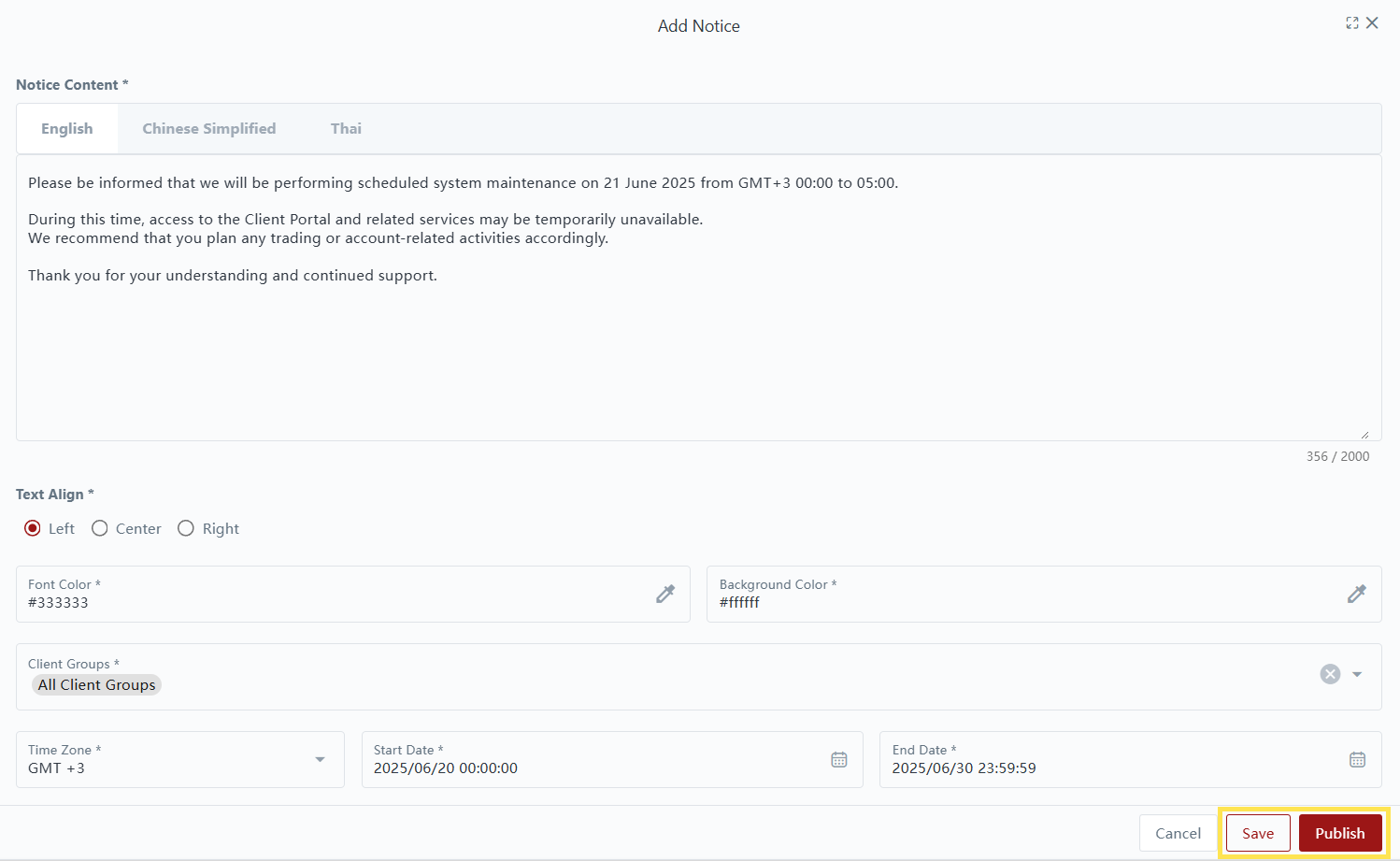
1. **Title** – Enter the main title of your notice.
1. Multi-Language Support – Click the "Language" icon to input content in multiple languages.
2. The available language fields will match those enabled for your Client Portal.\
\

2. **Content** – Fill in the notice body. You may enter different versions for each enabled language.\
Note: Maximum 2,000 characters per language version.
3. **Text Alignment** – Choose between Left, Center, or Right alignment.
4. **Font & Background Colour** – Customise the appearance of the notice using your brand colours.
5. **Client Groups** – Select which client groups should see this notice, allowing for targeted delivery.
6. **Time Settings** – Set the Timezone, Start Date, and End Date for when the notice should be displayed.
1. Start Date: You may only select today's date or a future date.
2. End Date: Must be the same as or later than the Start Date.
{% endstep %}
{% step %}
#### Save or Publish Your Notice
Once complete, choose one of the following:
1. Click "Save" to keep the notice as a draft and return to it later.
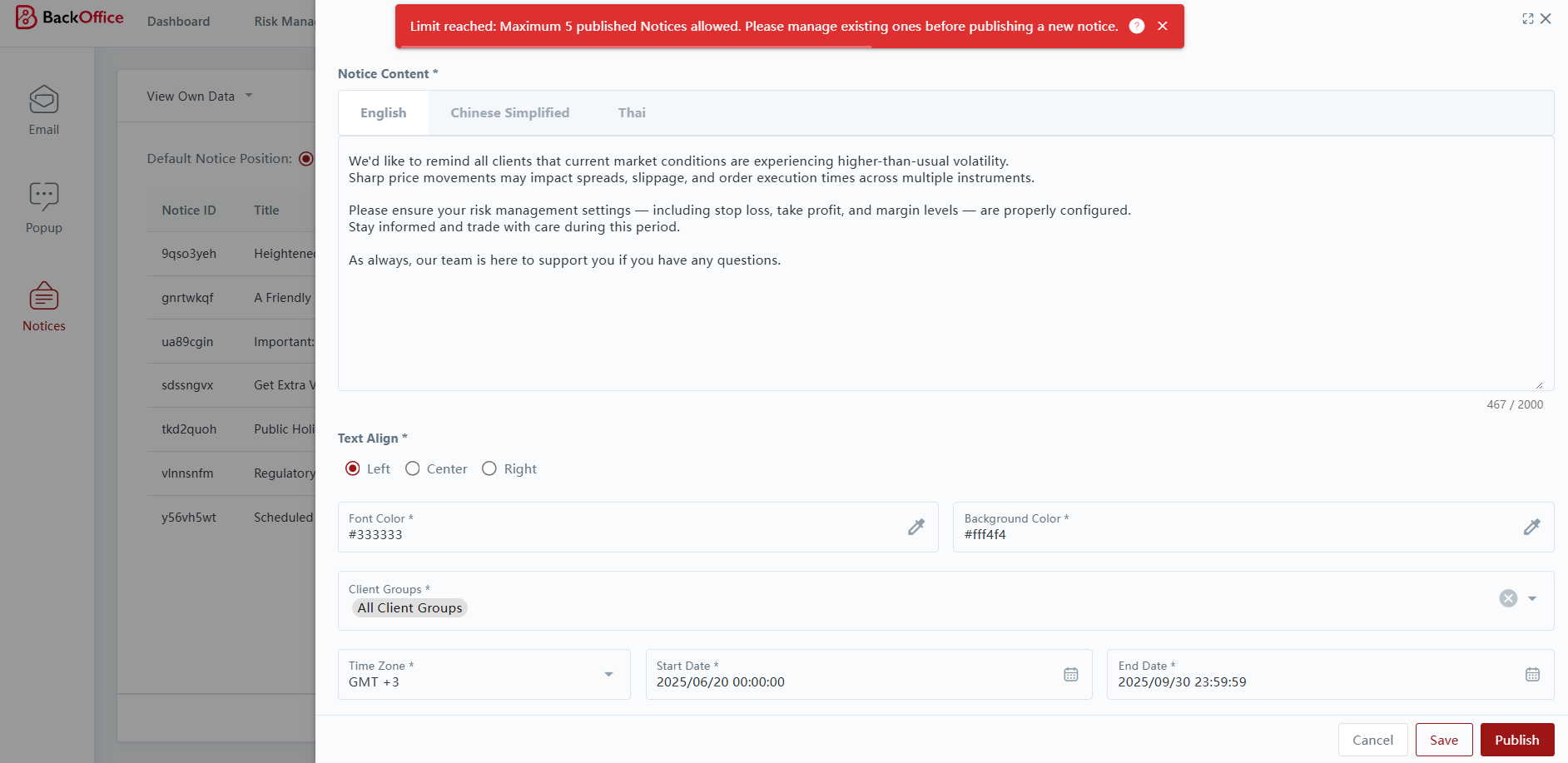
2. Click "Publish" to confirm and schedule the notice for display. You can have a maximum of 5 published notices at any given time. If you reach this limit, you will need to delete an existing notice before publishing a new one.
3. Once you have saved or published your notice, it will appear in the Notices list where you can monitor and manage all entries. Each notice will display its current status:
* Draft — The notice has been saved but not yet published or scheduled to show on the Client Portal.
* Published — The notice has been confirmed for display and will appear on the Client Portal according to its scheduled start and end dates.
{% endstep %}
{% endstepper %}
### 4) Notice Operations
You can perform the following actions to manage your notices efficiently:
View Notices
1. Locate the notice you want to view and click the "View" icon.
2. You can see all details of the notice but cannot make edits in view mode. Edit Notices
1. Locate the notice you want to edit and click the "Edit" icon.
2. Make the necessary amendments to any fields.
3. Click "Save" to keep changes as a draft or "Publish" to update the notice status.
4. Notice Status Behavior on Edit:
1. Editing a "Draft" Notice keeps it in "Draft" status.
2. Editing a "Published" Notice changes its status to "Pending Update". You will need to publish it again for the changes to take effect.
3. Editing a "Pending Update" Notice keeps it in "Pending Update" status.
4. Notices with "Disabled" or "Expired" status cannot be edited. The "Edit" icon will not be visible for these notices. Publish Notices
1. The "Publish" icon is available only for notices in Draft or Pending Update status.
2. To publish a notice, simply click the "Publish" icon.
3. You can have a maximum of 5 published notices simultaneously. If the limit is reached, attempting to publish another notice will trigger a notification warning.
4. To publish a new notice, please disable or delete an existing published notice first.
Disable Notices
1. The "Disable" icon is available only for notices that have been published.
2. To disable a notice, simply click the "Disable" icon.
3. Once disabled, the notice will no longer be visible to clients, even if it is still within the scheduled display period.
4. To re-enable the notice, simply click the "Re-enable" icon. It re-enabled and within its valid display period, the notice will be shown again on the client portal. Copy Notices
1. You can duplicate an existing notice to reuse content or settings.
2. Locate the notice you want to copy and click the "Copy" icon.
3. A new draft notice with the copied content will be created. You will be redirected to the Edit Notice page to make any necessary changes. Delete Notices
1. You can delete any notice regardless of its status.
2. Locate the notice you want to delete and click the "Delete" icon.
3. A confirmation popup will appear. Click "Confirm" to proceed with deletion. \
\

### 5) Viewing Notices on Client Portal
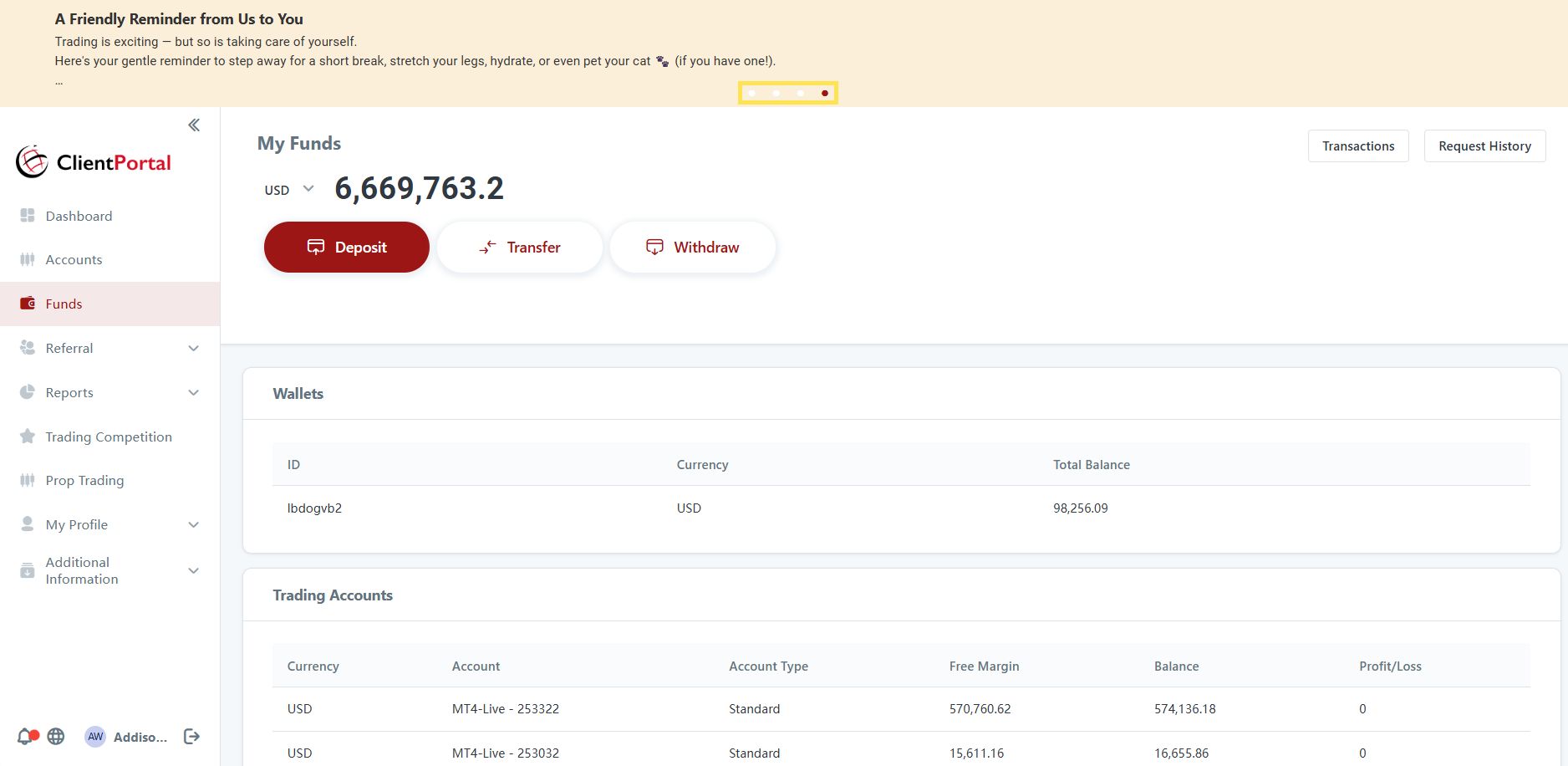
1. Clients will see published notices displayed at the top or bottom of the portal, based on your configured default position.
2. Notices remain visible across all pages within the Client Portal, ensuring consistent visibility regardless of where clients navigate.
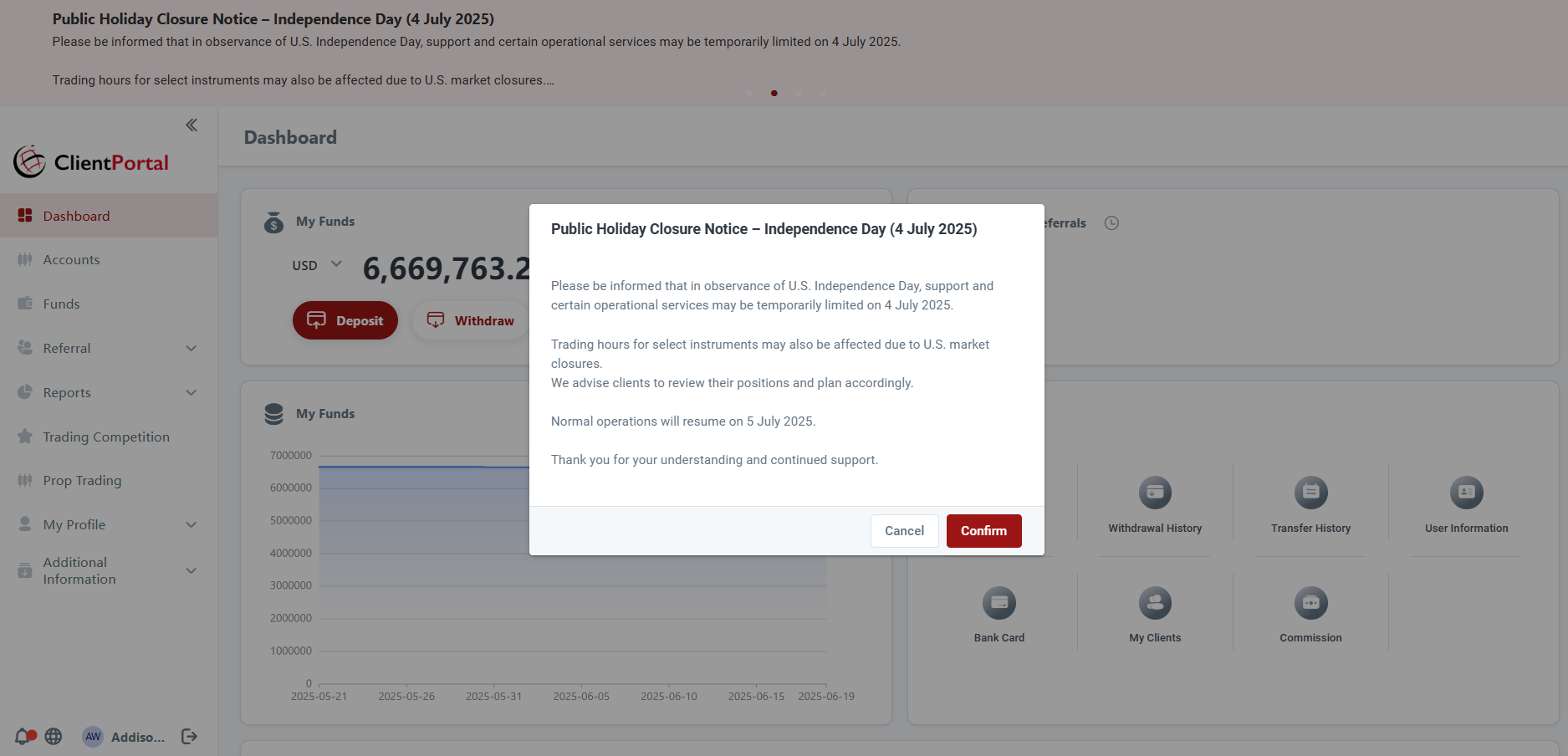
3. If a notice message exceeds the banner length, it will be truncated with a **“...”** at the end.
4. Clients can click on the banner to open and view the full message in a larger format.
5. When multiple notices are published, the system will automatically rotate between them every 10 seconds.
6. Clients can also manually navigate between notices by clicking the left and right arrows on the banner.
7. At the bottom of the banner, navigation dots indicate the number of published notices and help users track which notice they’re currently viewing.