> For the complete documentation index, see [llms.txt](https://reference-guide.gitbook.io/crm-version-release-notes/llms.txt). Markdown versions of documentation pages are available by appending `.md` to page URLs; this page is available as [Markdown](https://reference-guide.gitbook.io/crm-version-release-notes/v5.13.0-multiple-kyc-forms-for-different-kyc-requirements.md).
# V5.13.0 - Multiple KYC Forms for Different KYC Requirements
Learn about all the details of all our recent CRM updates here.
#### Released Date - 28 Dec 2022
In this release, you can now create multiple KYC forms and customize the fields to cater to different KYC requirements. This allows your onboarding process to cover a full spectrum of KYC requirements for different client types (e.g. corporate or retail clients) and jurisdictions.
## Multiple KYC Forms
### 1) Creating a new KYC Form
{% tabs %}
{% tab title="Step 1" %}
1. By default, the existing KYC form on your CRM will be called “Unnamed”.
2. You can create a new form by clicking “Create Form”.
{% endtab %}
{% tab title="Step 2" %}
Type in the form name in the respective languages.
* Form names cannot be duplicated.
* Form names can be up to 100 characters only.
* You can create up to 20 forms only.

{% endtab %}
{% tab title="Step 3" %}
Once you have created a new form, you will be able to edit the fields for the form.
1. Click onto the form that you wish to edit.
2. Upon clicking the form, you will notice an “>” button and the fields of the form will be displayed.
3. By default, the fields displayed will be:
* Basic Information
* Documents
{% endtab %}
{% tab title="Step 4" %}
You can proceed to create, edit, or delete the fields for the KYC form.
{% endtab %}
{% endtabs %}
### 2) Renaming of KYC Form
{% tabs %}
{% tab title="Step 1" %}
1. Select the form you wish to edit.
2. Click onto the “>” icon and click “Edit”.\

{% endtab %}
{% tab title="Step 2" %}
Amend the form name and click “Confirm”.\

{% endtab %}
{% endtabs %}
### 3) Disabling of KYC Form
{% tabs %}
{% tab title="Step 1" %}
1. By default, all new forms created will be enabled.
2. Select the form you wish to disable.
3. Click onto the “>” icon and click “Disable”. If you only have one form that is enabled, you will not be able to see the “Disable” button.\

{% endtab %}
{% tab title="Step 2" %}
A pop-up notice will appear to inform you that disabling the form may result in the loss of KYC data for existing clients. Click "Confirm" to proceed.

{% endtab %}
{% tab title="Step 3" %}
Once you disable the form, you will see \[Disabled] beside the respective form name.\

{% endtab %}
{% tab title="Step 4" %}
If you disable a form:
1. You and your clients will still be able to see the data that they have filled in previously.
2. However, if you or your client edits their KYC details, the previous data will be lost, and client will have to select a new form and fill in the details again.
3. If the form is re-enabled and client did not edit their KYC details, the data filled in previously will remain.
{% endtab %}
{% endtabs %}
### 4) Deletion of KYC Form
{% tabs %}
{% tab title="Step 1" %}
1. Select the form you wish to delete.
2. Click onto the “>” icon and click “Delete”.\

{% endtab %}
{% tab title="Step 2" %}
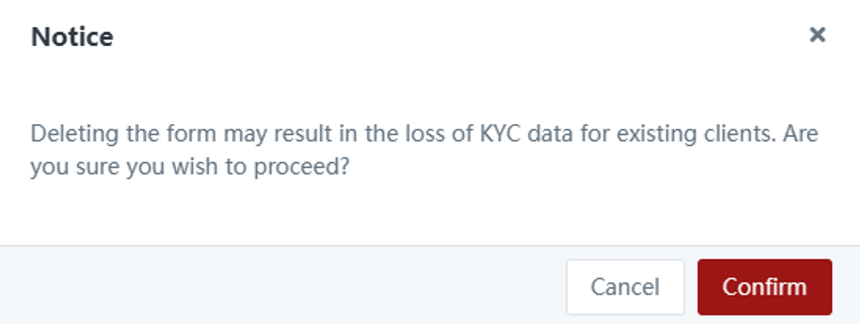
A pop-up notice will appear to inform you that deleting the form may result in the loss of KYC data for existing clients. Click “Confirm” if you wish to proceed.
{% endtab %}
{% tab title="Step 3" %}
If you delete a form:
1. Clients will still be able to see the data that they have filled in previously.
2. However, if the client edits their KYC details, the previous data will be lost, and client will have to select a new form and fill in the details again.
{% endtab %}
{% endtabs %}
### 5) Form Type Settings
{% tabs %}
{% tab title="Description" %}
You can amend the description shown to clients.
1. Click onto the Settings icon.
2. Fill in the Description in the respective languages.
3. Client’s will be able to see this description when submitting their KYC request.
{% endtab %}
{% tab title="Form Order" %}
You can arrange the order of the forms to be shown to clients. Click onto the following icon and arrange the form according to the order you prefer.

{% endtab %}
{% endtabs %}
## Submitting KYC Request via Client Portal
### 1) New Clients
{% tabs %}
{% tab title="Step 1" %}
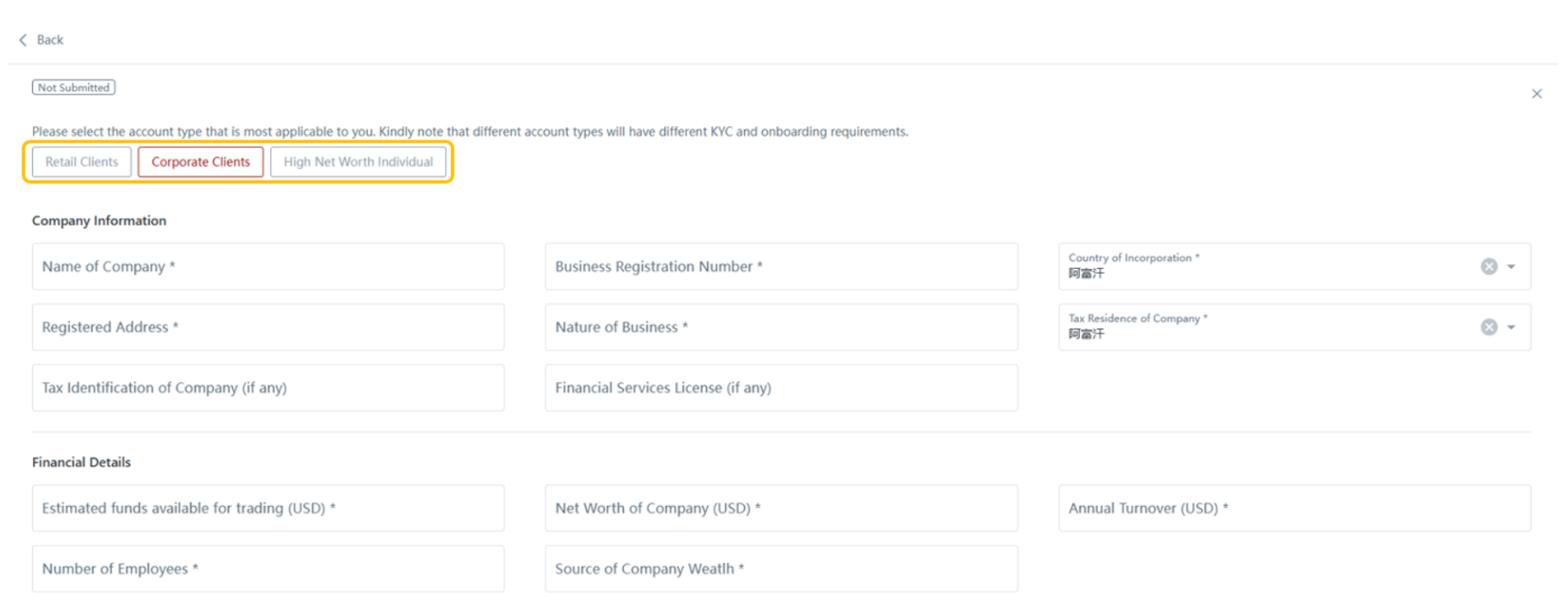
The client will need to select the form applicable to them and click “Next”.
{% endtab %}
{% tab title="Step 2" %}
1. The KYC fields will be displayed upon selection.
2. Client can fill in the fields accordingly and submit the request.
{% endtab %}
{% tab title="Step 3" %}
This applies to multi-step registration as well.
1. This means that on Backoffice Settings - Login/Registration Settings, you enabled “Fill in KYC information during registration”.
2. When registering an account, the client will need to select the respective form that is most applicable to them.
3. The KYC fields will be displayed upon form selection. Client can fill in the fields accordingly and submit the account creation request.
{% endtab %}
{% endtabs %}
### 2) Existing Clients
{% tabs %}
{% tab title="Step 1" %}
1. The default form name selected is “Unnamed”, if no changes has been made by you yet.
2. The client will be able to see the data they filled in previously.
{% endtab %}
{% tab title="Step 2" %}
If they edit and select a new form, the data will be lost, and they will need to fill in their information accordingly.
{% endtab %}
{% endtabs %}
## KYC Management via Backoffice Portal
### 1) Editing of KYC Details on Client Details Page
{% tabs %}
{% tab title="New Clients" %}
1. You will need to select the form applicable to the client.
2. The respective KYC form fields will display.
3. You can fill in the details accordingly and click “Save”.
{% endtab %}
{% tab title="Existing Clients" %}
1. The default form name selected is “Unnamed”, if no changes have been done yet.
2. You will be able to see the data client filled in previously.
3. If you edit and select a new form, the data will be lost, and you will need to fill in client information accordingly.
{% endtab %}
{% endtabs %}
### 2) Reviewing of KYC Request
{% tabs %}
{% tab title="Step 1" %}
You will be able to view the form selected and the respective fields filled in by the client.
{% endtab %}
{% tab title="Step 2" %}
If you edit and select a new form, the data will be lost, and you will need to fill in client information accordingly.
{% endtab %}
{% endtabs %}
### 3) Creation of KYC Request
{% tabs %}
{% tab title="New Clients " %}
1. When creating a KYC request for new clients, you will need to click “Create”.
2. Select the respective client and click “Proceed to KYC”.

3. Select the form applicable to the client.
4. The respective KYC form fields will display.
5. You can fill in the details accordingly and click “Submit”
{% endtab %}
{% tab title="Existing Clients" %}
1. When creating a KYC request for existing clients, you will need to click “Create”.
2. Select the respective client and click “Proceed to KYC”.
3. The default form name selected is “Unnamed”, if changes have not been made yet.
4. You will be able to see the data client filled in previously.
5. If you edit and select a new form, the data will be lost, and you will need to fill in client information accordingly.
6. Click “Submit”.
{% endtab %}
{% endtabs %}
### 4) Reviewing of Trader Registration Request
{% tabs %}
{% tab title="Step 1" %}
1. This means that on Backoffice Settings - Login/Registration Settings, you enabled “Fill in KYC information during registration”.
2. You will be able to see the form type selected by the client and the respective KYC fields here.
{% endtab %}
{% tab title="Step 2" %}
If you edit and select a new form, the data will be lost, and you will need to fill in client information accordingly.
{% endtab %}
{% endtabs %}