> For the complete documentation index, see [llms.txt](https://reference-guide.gitbook.io/crm-version-release-notes/llms.txt). Markdown versions of documentation pages are available by appending `.md` to page URLs; this page is available as [Markdown](https://reference-guide.gitbook.io/crm-version-release-notes/v7.40.0-luqapay-integration.md).
# V7.40.0 - LuqaPay Integration
Learn about all the details of all our recent CRM updates here.
**Released Date - 4 April 2025**
We’re pleased to announce the integration of LuqaPay with your CRM—a peer-to-peer payment solution built to simplify and modernize fund transfers. Designed for speed, flexibility, and transparency, LuqaPay connects your traders to a wider community network, allowing deposits and withdrawals to be automatically matched across the ecosystem—not just within your client base.
With this integration, you can offer your clients a streamlined alternative to traditional banking channels, while maintaining full visibility and control over transaction flows. Real-time balance tracking and automated fund reconciliation are available directly via the LuqaPay platform, ensuring operational efficiency at every step.
{% hint style="warning" %}
Currently, only the Japan Community Bank Transfer method is supported.
{% endhint %}
### **Key Function Highlights**
1. **Peer-to-Peer Matching System:** Tap into the full LuqaPay network to automatically pair deposit and withdrawal requests across the ecosystem. Rather than limiting matches to clients within the same broker, LuqaPay’s shared pool enables faster and more efficient fund movement—minimizing manual oversight and boosting transaction success rates.
2. **Localized Payment Method:** Tailored for the Japanese market, LuqaPay's Community Bank Transfer method offers a familiar and trusted payment route for local traders. It simplifies fund transfers, aligning with domestic banking practices and enhancing user confidence in the process.
3. **Real-Time Deposit & Withdrawal Matching:** Through the CRM Client Portal, traders can instantly view available withdrawal requests that match their intended deposit amounts. This feature speeds up the funding process, reduces wait times, and helps prevent unmatched transactions—resulting in a smoother, more efficient user experience.
4. **Automatic Withdrawal Timeout and Refunds:** If a withdrawal request remains unmatched for 72 hours, it is automatically canceled and refunded to the client. This safeguard ensures timely fund returns, prevents unnecessary delays, and reinforces the reliability of the LuqaPay system.
### 1) Marketplace Installation & Permission Settings
To begin using LuqaPay, you’ll first need to install it from the CRM Marketplace. Follow the steps below to complete the installation:
{% stepper %}
{% step %}
#### Access the CRM Marketplace
1. Log in to your CRM back office portal.
2. Navigate to the CRM Marketplace.
{% endstep %}
{% step %}
#### Install LuqaPay
1. Locate LuqaPay and click onto it.
2. You will be redirected to the details page.
3. Click "Install" to begin the installation process.
{% endstep %}
{% step %}
#### Enable Permissions
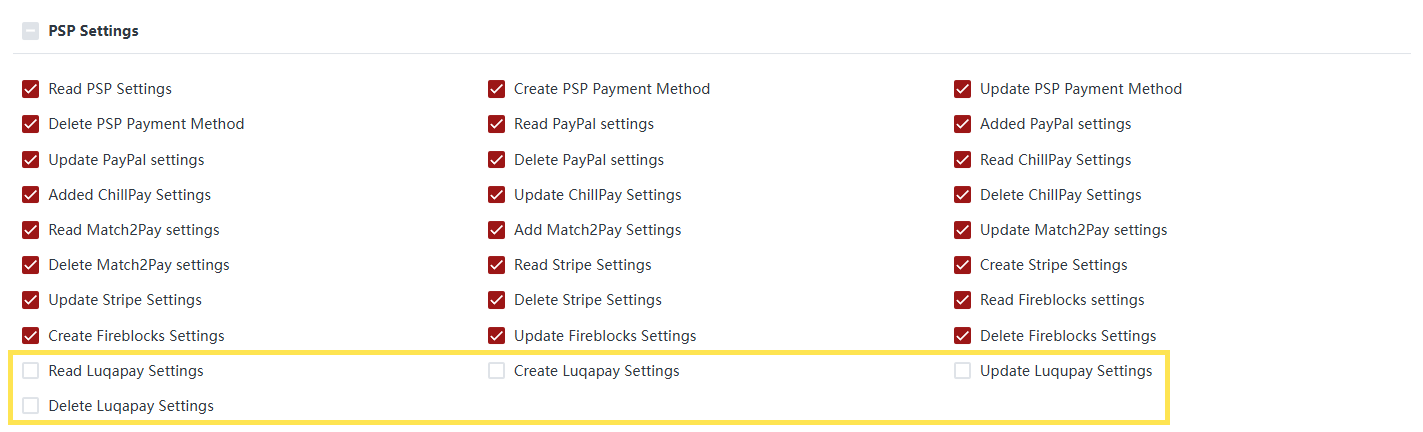
After installation, you must assign the appropriate permissions to users who will manage LuqaPay settings. These include:
1. **Read LuqaPay Settings** – Allows view-only access.
2. **Create LuqaPay Settings** – Grants permission to create new LuqaPay configurations.
3. **Update LuqaPay Settings** – Allows updates to existing LuqaPay settings.
4. **Delete LuqaPay Settings** – Grants the ability to remove LuqaPay configurations.
{% endstep %}
{% endstepper %}
### 2) Security Checklist
After installation and permission setup, you will find LuqaPay Settings under PSP Settings in your CRM.
This section includes a **Security Checklist** that outlines recommended security enhancements—particularly useful for online deposit and withdrawal workflows. While optional, completing these steps is strongly advised to strengthen your overall platform security.
The system will automatically detect and mark each requirement as completed once the relevant configuration is in place.
Mandatory 2FA Verification
Mandatory two-factor authentication (2FA) helps prevent unauthorized access to your CRM. To setup, follow these steps:
1. Click "Go Now" to be redirected to Settings > Client Portal Settings > Security Settings.
2. Click the "Edit" icon.
3. Enable Mandatory 2FA.
4. You may select which application scenarios should require 2FA.
5. Note: "Login" is mandatory and cannot be disabled.
6. Click "Save".
7. Once mandatory 2FA is enabled, this step will be automatically marked as complete in the checklist. Multi-Level Approval Installation
This adds an extra layer of verification for sensitive actions like withdrawals. To install Multi-Level Approval, follow these steps:
1. Click "Go Now" to be redirected to the CRM Marketplace.
2. Search for "Multi-Level Approval" and click on the listing.
3. You will be redirected to the details page.
4. Click "Install" to proceed.
5. Once installed, the checklist item will be marked as completed. Setup Multi-Step Approval for Withdrawals
This ensures withdrawal requests go through at least two levels of verification. To setup, follow these steps:
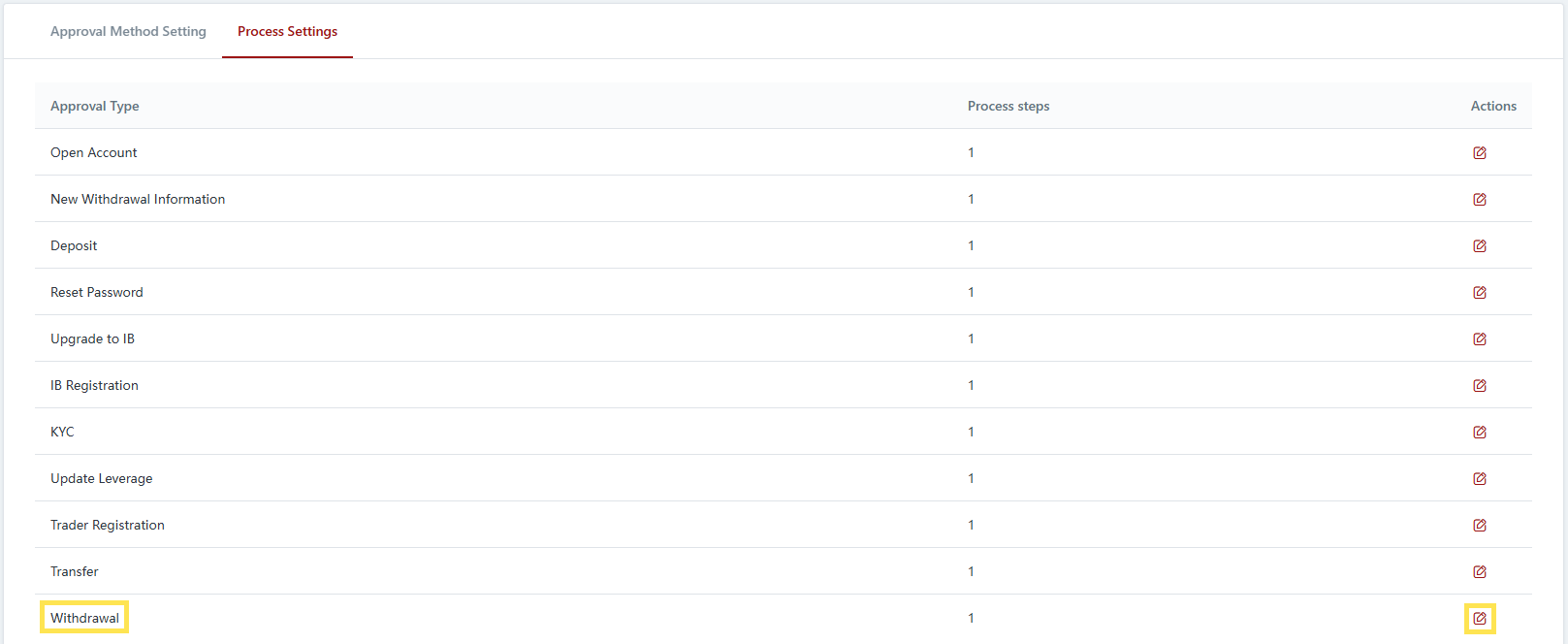
1. Click "Go Now" to be redirected to Settings > Approval Settings > Process Settings.
2. Locate the Withdrawal process and click the "Edit" icon.
3. Click the "+" icon to add a new level.
4. Select "No approver" and assign the responsible party for each level. \
\

5. You can assign either individual users or roles. \
\

6. Click "Confirm". \
\

7. It is recommended to have at least 2 levels of approvers:
* First Level: Deduct Level of Approval. Upon approval, the withdrawal amount will be deducted from the trading account or wallet.
* Second Level: Payout Level of Approval. Upon approval, the withdrawal request will be sent to LuqaPay and the funds will be paid out to your client.
8. Upon adding the second level of approver, the first level will automatically be assigned both the "Deduct" and "Payout" approval. To set the second level as the "Payout", click the "Payout" icon. \
\

9. For the first level, you can choose between manual or automatic approval. It is recommended to select manual approval so you can review the withdrawal request and its details before processing. To setup:
1. Click on the "Settings" icon. \
\

2. Select "Manual" and click "Confirm". \
\

10. Click "Publish" to save your changes.
11. After publishing, this checklist item will be marked as completed.
### 3) Create LuqaPay Settings
To create LuqaPay settings, follow these steps:
{% stepper %}
{% step %}
#### Retrieve Details from LuqaPay
1. Login to your LuqaPay account.
2. Navigate to "Accounts".
3. Retrieve your "API Key" and "Secret Key".
{% endstep %}
{% step %}
#### Create LuqaPay Settings on CRM
1. Navigate to Settings > PSP Settings > LuqaPay Settings.
2. Click "Create".
{% endstep %}
{% step %}
#### Configure LuqaPay Settings
Fill in the respective fields and click "Save".
* Name
* API Key — retrieved from the LuqaPay portal
* Secret Key — retrieved from the LuqaPay portal
* Select Environment: Sandbox or Production
* Payment Method: The only available option is "Community Bank Transfer".
* Deposit Matching Buffer (+/-):
* Fill in positive integers only.
* Defines the range around the deposit amount that your clients can choose from when making a deposit via LuqaPay.
* For example, if your client wants to deposit $1,000 and the Deposit Matching Buffer is set to $100, the available deposit options will range from $900 to $1,100.
{% endstep %}
{% endstepper %}
### 4) View, Edit & Delete LuqaPay Settings
You will be able to perform the following actions on your LuqaPay Settings:
View Settings
To view LuqaPay settings, follow these steps:
1. Locate the specific LuqaPay setting you wish to view.
2. Click on the "View" icon.
3. You will be able to see all the configured settings.
Edit Settings
To edit LuqaPay settings, follow these steps:
1. Locate the LuqaPay settings you want to edit.
2. Click on the "Edit" icon.
3. Make the necessary amendments.
4. Click on "Save" to save the updated settings. Delete Settings
To delete LuqaPay settings, follow these steps:
1. Locate the LuqaPay settings you want to delete.
2. Click on the "Delete" icon.
3. A confirmation popup notice will appear.
4. Click "Confirm" to proceed with the deletion.\
\

5. Please note that if the LuqaPay setting is being used by an existing deposit method, you will not be able to delete it.
### 5) Create LuqaPay Deposit Method
To setup LuqaPay as a deposit method, follow these steps:
{% stepper %}
{% step %}
#### Create LuqaPay Icon
Creating this icon allows you to assign it to your deposit method, helping your clients easily identify LuqaPay among other deposit options.
1. Navigate to Transaction Settings > Payment Gateway Icon.
2. Click "Create".
3. Enter the name for the icon.
4. Upload an image for the icon. Make sure it is 200x200 pixels, has a transparent background, and is in PNG format.
5. Click "Save".
{% endstep %}
{% step %}
#### Create Payment Method
1. Navigate to Transaction Settings > Deposit Settings.
2. Under "Payment Method Settings", click "Create".\
3. Fill in the details:
1. Select **Platform**: Choose LuqaPay – Japan Community Bank Transfer
2. Select **Icon**: Choose the LuqaPay icon
3. Select **Clients or Client Groups**: Specify which clients or groups this deposit method applies to.
4. **Method**: Enter the name of the payment method.
5. **Supported Currencies**: Currently, only JPY is available
6. Fill in these values as required: **Decimals, Minimum Deposit, Maximum Deposit, Fee, and Maximum Fee**.
4. **Use External Exchange Rate**: Check this if you want to use your own exchange rate source for converting JPY to the client’s account currency.
5. **Show Trading Amount**: Checked by default; this will display both the payment amount and the actual deposited amount for the client’s reference.
6. The deposit fields shown are mandatory and required by LuqaPay.
7. You can add custom deposit fields if needed by clicking the "Create" icon.
8. Click Save to save your payment method configuration.
{% endstep %}
{% step %}
#### **Ensure Exchange Rate is Set**
If you did not enable the **"Use External Exchange Rate"** option when creating the LuqaPay payment method, you must manually configure the exchange rate for **JPY**.
To set the exchange rate:
1. Go to "Exchange Rates".
2. Locate "JPY" in the currency list and click the "Edit" icon.
3. Assign Client Groups
1. Select the client groups this exchange rate should apply to.
2. You can set different exchange rates for different client groups by clicking "Add Exchange Rate".
3. Setting the client group as "Other Client Groups" means any groups not explicitly configured will follow this rate.
4. Configure the Type:
* Manual: Enter the exchange rate manually.
* Auto Update:
* Choose your preferred exchange rate source.
* Enter a markup % if you wish to apply one.
5. Display Exchange Rate (optional):
* Check this option if you want clients to view the current exchange rate in their portal.
6. Click "Save" to apply your settings.
{% endstep %}
{% endstepper %}
### 6) Create LuqaPay Withdrawal Method
To setup LuqaPay as a withdrawal method, follow these steps:
{% stepper %}
{% step %}
#### Create Withdrawal Method
1. Navigate to Transaction Settings > Withdrawal Settings.
2. Scroll down to "Withdrawal Method Settings".
3. Click "Create".
{% endstep %}
{% step %}
#### Configure Withdrawal Method Settings
Fill in the details:
1. Select **Platform**: Choose LuqaPay – Japan Community Bank Transfer
2. **Method Name**: Enter the name of the withdrawal method.
3. Select **Clients or Client Groups**: Specify which clients or groups this withdrawal method applies to.
4. **Supported Currencies**: Currently, only JPY is available
5. Fill in these values as required: **Minimal Withdrawal, Maximum Withdrawal, Fee and Maximum Fee.**
6. The withdrawal fields shown are mandatory and required by LuqaPay.
7. You can add custom withdrawal fields if needed by clicking the "Create" icon.
8. Click Save to save your withdrawal method configuration.\
\

{% endstep %}
{% step %}
#### **Ensure Exchange Rate is Set**
Similarly, ensure that the exchange rate for JPY is configured. Follow the same steps as outlined for payment method.
{% endstep %}
{% endstepper %}
### 7) Client Deposit via LuqaPay
To deposit funds via LuqaPay, your clients can follow these steps:
{% stepper %}
{% step %}
#### Deposit Funds
1. Login to CRM Client Portal.
2. Navigate to Funds.
3. Click "Deposit".
{% endstep %}
{% step %}
#### Fill in Deposit Form
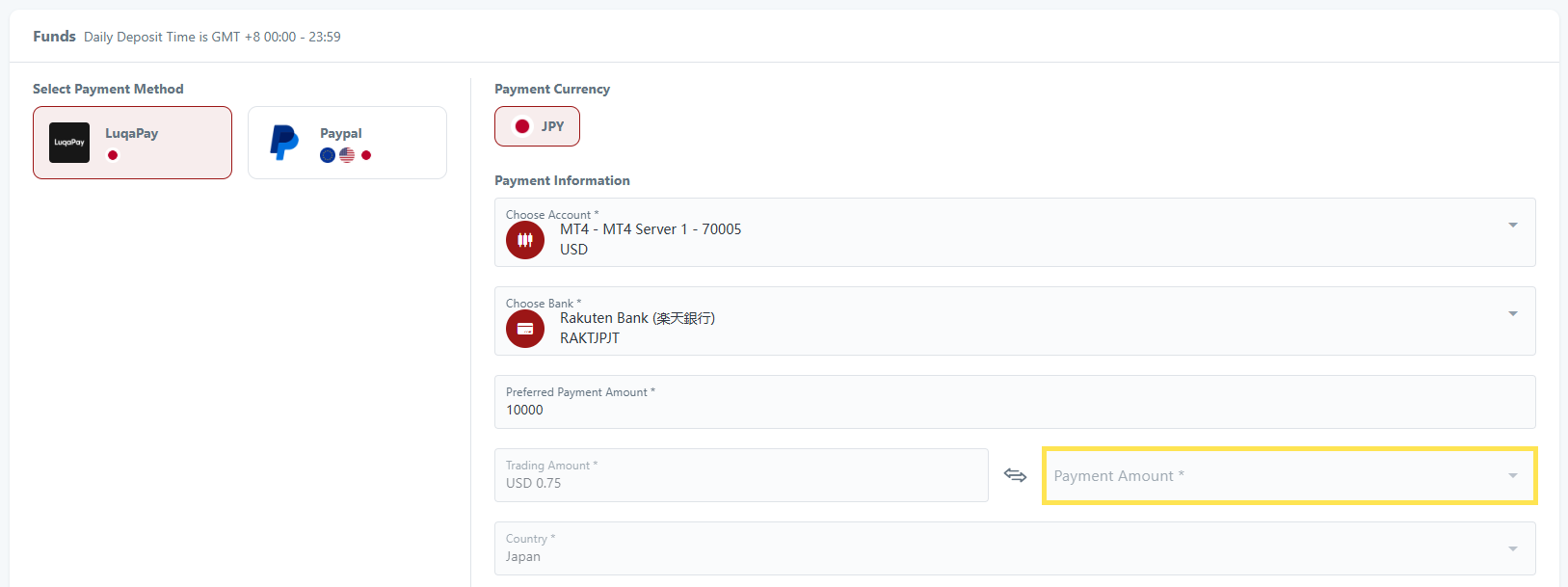
1. Select "LuqaPay" as the payment method.
2. **Currency**: “JPY” will be selected by default, as it is the only supported currency.
3. Choose the **Account** to which the funds will be deposited.
4. **Select the Bank**: A dropdown list will display all banks supported under LuqaPay – Japan Community Bank Transfer.
5. Enter the **"Preferred Payment Amount"**.
6. The system will automatically generate a list of available **Payment Amounts**, based on the Deposit Matching Buffer you’ve configured.
* If available options are found, your client can click **“Payment Amount”** to view a dropdown menu of matched values and select their preferred one.
* If no matches are found, the **“Payment Amount”** field will be disabled. The client can revise their preferred payment amount to try and find a match.
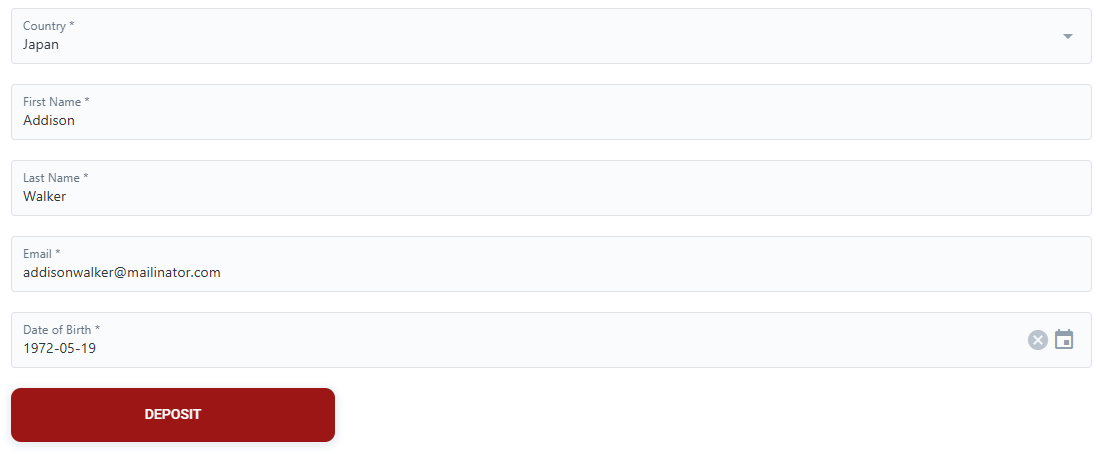
7. Complete the required fields:
* **Country**: Only “Japan” is available
* **First Name**
* **Last Name**
* **Email**
* **Date of Birth**
* If your client’s KYC has been approved and these fields (Email and Date of Birth) are part of your KYC fields (CRM Default Fields), the information will be automatically populated. However, clients can still edit the details if necessary.
8. Click “Deposit” to proceed.
9. A confirmation popup will appear for the client to review payment details. Click “Pay Now” to submit the request.\
\

10. After confirming, the client will be redirected to the bank payment page to complete the payment.\
\

{% endstep %}
{% step %}
#### Review Deposit Request
1. Once your client is redirected to the bank page to complete the payment, a deposit request will be generated in the CRM—regardless of whether the client has completed the payment.
2. Navigate to CRM Back Office > Approval > Deposit.
3. Click "Review" on the deposit request you wish to assess.
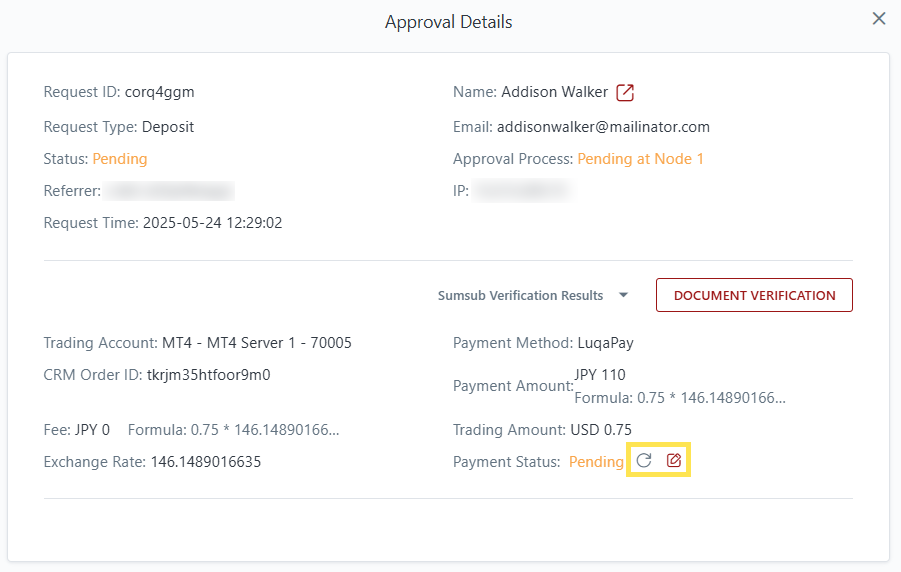
4. The Payment Status will initially appear as "Pending".\
\

5. You can refresh the payment status by clicking the “Refresh” icon. If needed, you may also manually update the payment status by clicking the “Edit” icon.
6. Any action taken—whether refreshing or editing—will be recorded in the log section below for audit purposes.
7. If the client has successfully completed the payment and LuqaPay reflects a **"Success"** status, this status will be updated in the CRM.
8. Note: LuqaPay's IPN callback may return multiple statuses. The CRM will only update the payment status to “Success” if the callback explicitly indicates a “Success” status.
9. You can then proceed to Approve or Reject the deposit request.
10. If your Approval Settings for deposit requests are configured to Automatic, the system will automatically approve the request upon receiving a “Success” callback.
{% endstep %}
{% endstepper %}
### 8) Client Withdraw via LuqaPay
To withdraw funds via LuqaPay, your clients can follow these steps:
{% stepper %}
{% step %}
#### Withdraw Funds
1. Login to CRM Client Portal.
2. Navigate to Funds.
3. Click "Withdraw".
{% endstep %}
{% step %}
#### Fill in Withdrawal Form
1. Select the account you wish to withdraw from.
2. Enter the withdrawal amount.
3. Choose "LuqaPay" as your withdrawal method.
4. Select the withdrawal currency. Currently, only JPY is supported.
5. Choose your bank and fill in the required details.
6. At the bottom of the withdrawal form, your client will be informed that this is a Community Bank Transfer withdrawal request. The request will be listed and matched with another client looking to deposit the same amount. If no match is found within 72 hours, the request will be automatically cancelled and the amount refunded to the account.
7. Click “Submit” to complete the request.
{% endstep %}
{% step %}
#### Review Withdrawal Request
1. Navigate to CRM Back Office > Approval > Withdrawal.
2. Click "Review" on the withdrawal request you wish to assess.
3. Review the request and click "Reject" or "Approve". \
\
\
4. Upon first-level approval:
1. Funds will be deducted from the client's account, and the CRM Balance Status will be updated to "Deducted".
2. If the "Payout" action is configured to trigger at the first level, the withdrawal request will be sent to LuqaPay for processing. The payment status will be updated to "Pending".
5. Upon Second-Level Approval:
1. If the “Payout” action is set to trigger at the second level instead, the withdrawal request will be sent to LuqaPay at this stage.
2. The payment status will be updated to "Pending."
6. If the withdrawal is successfully matched with a deposit request from another client, the payment status will be updated to "Success."
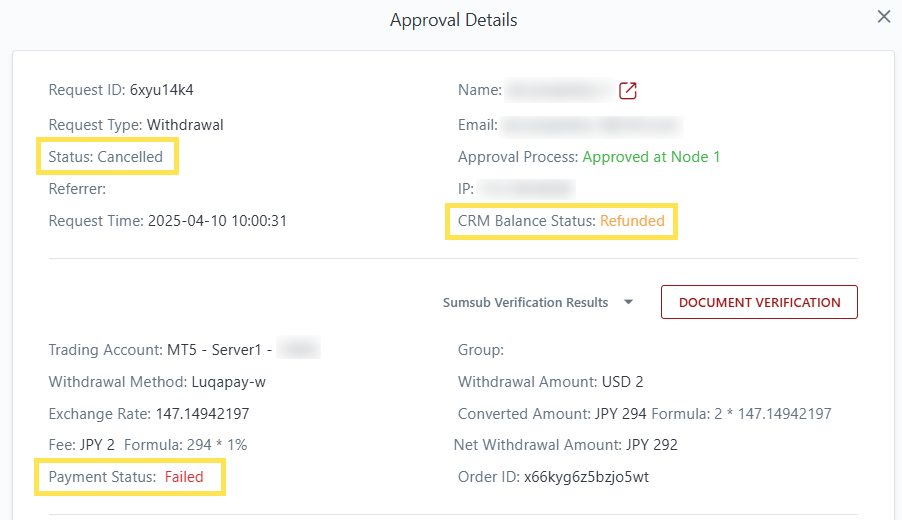
7. If no match is found within **72 hours**, the payment status will change to **"Failed,"** and the deducted funds will be automatically **refunded** to the client.
8. The CRM balance status will then be updated to **"Refunded."** The status of the request will also be updated to "Cancelled".
{% endstep %}
{% endstepper %}